• Skip to primary navigation
  • Skip to main content
  • Skip to primary sidebar
  • Skip to footer

Justyna Dorsz

  • Blog
  • Store
  • Contact
  • About

Mindset

We are bad at judging our own work

I made a lot of designs, and sometimes I hesitated before publishing some of them. I never know how something is going to be received. Sometimes I think, “no one is going to buy it, what’s the point”. But by now, I also know that it’s impossible to predict how well a design is going to sell.

Take this Space design as an example:
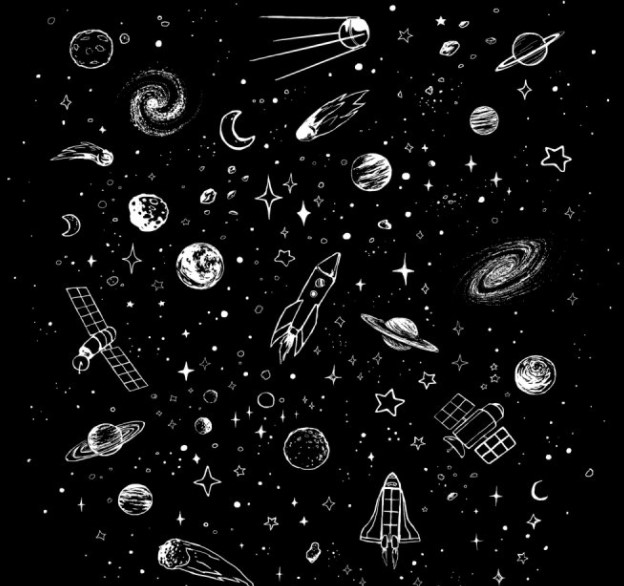
I think I first submitted it to my Threadless store, where I sent most of my designs. It wasn’t very popular. But I knew that sometimes different websites have different audiences — what might sell well on Threadless might not sell on, say, TeePublic or Redbubble, and vice versa. So I added this design to my Redbubble store. And it has been selling very well there. It’s my most popular design on Redbubble, and I often get messages from customers when they buy it. Here are some of them:

  • This is going in my husband’s space-themed reading nook for his birthday. Wonderful job guys!
  • Thank you. My future space travel buddy will love this 😉
  • Perfect for my next astronomy courses.
  • Love the simplistic design!!
  • Absolutely love this design, can’t wait to receive my phone case – thank you for your creativity!

Those are all comments from people who loved the design. And there are many more. Whenever I read the messages I am always surprised — they not only liked my art enough to buy it but they also took the time to write to me! Just imagine — had I listened to my inner voice telling me not to publish it, those people would not have an opportunity to see the design and get something they liked so much. They sometimes even thank me for creating the design, when it should be me thanking them for supporting me.

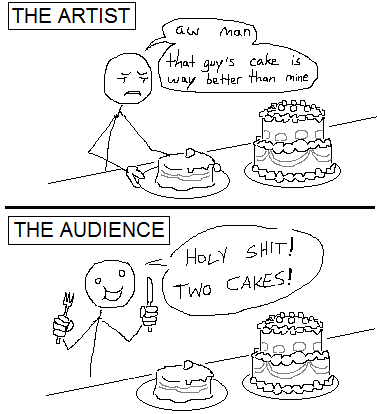
We artist notoriusly doubt ourselves. This is maybe the most accurate visualization of all this:
image
Artist: stuffman Source: the-artist-putting-a-simple-cake-next-to-a-much

June 27, 2021 Tagged With: Artist Life, Doubt, Mindset, Space

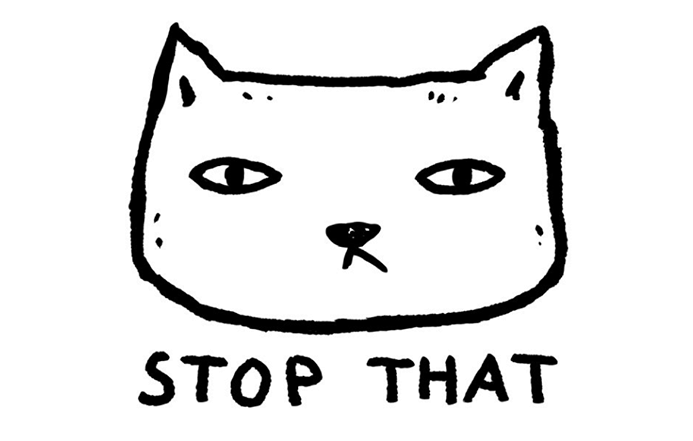
Stop that

The other day I was at a hairdresser’s, and a woman sitting next to me was complaining about everything, and I mean everything. That she had to cook dinners and it took a lot of time and she hated it. That it rained too much. That these were difficult times. That it was too hot on sunny days. That women were shallow and cared too much about their looks. That men preferred those kinds of women.

Real-life situations often inspire my designs. I had to suffer listening to all that, but at least I knew what I wanted to draw when I got home:

“Stop That” in my TRUFFLEPIG store

That reminds me of an article I once read: “How Complaining Rewires Your Brain for Negativity”. It’s worth reading, but in case you don’t read it, here’s a relevant quote:

Repeated complaining rewires your brain to make future complaining more likely. Over time, you find it’s easier to be negative than to be positive, regardless of what’s happening around you. Complaining becomes your default behavior, which changes how people perceive you.

June 24, 2021 Tagged With: Cats, Design, Don't Complain, Mindset

Awesome t-shirt advertisement

Check out this video:

It’s of course an advertisement. But so well done! The key point is not the t-shirt but the idea that thinking of yourself as the Main Character can impact your life and mental health.

I like both the video and the concept that I am a central character in my story. I would buy the shirt if not for the fact that I already have too many t-shirts — being a designer means that you get A LOT of free t-shirts.

Here’s the link to the t-shirt: Be A Main Character. I am not affiliated with them, I just really like it and I think it might even be helpful to see the reminder that you are the Main Character every time you see yourself in the mirror.

April 30, 2021 Tagged With: Main Character, Mindset, Video

Daily vs. Dailyish

It’s much easier to stick to a habit if you make it a daily habit.

For my whole adult life, I’ve been trying to make a habit out of going to the gym and exercising regularly. I had always assumed that exercising 3 or 4 times a week was enough, so I set rules for myself like: go to the gym at least 3 times a week, or go for a run once every two days. And sure, sometimes I managed to stick to it for a few weeks. But, inevitably, I would be too lazy to exercise on Monday, and Tuesday, and Wednesday, and Thursday. And then I would have needed to go every day for the rest of the week — it seemed too much, it wasn’t the plan to have to exercise every day. I would get discouraged and abandon the whole idea. And then try again a few weeks later.

It wasn’t until I decided to go to the gym every day that I managed to make it a habit and stick to it. Only when a task is non-negotiable, a habit can be built.

April 4, 2021 Tagged With: Habit, Mindset

Sabotage

Recently someone asked for opinions about their designs. But they insisted on receiving “positive feedback only”.

What do you say to that? My standard response is, of course, to stay silent. If they haven’t asked for honest feedback, then it’s pointless to impose my opinion on them.

But I can’t help feeling that they are sabotaging themselves this way. They could ask for honest feedback, consider it, learn from it. If they don’t want to hear any criticism, how are they going to improve?

March 3, 2021 Tagged With: Mindset

Making a children’s book – some notes

A few weeks ago, my brother and I started working on our first children’s book about cats. This is a good time to write a bit about the process and why we decided on this project.

From the start it was a challenge:

  • Both my brother and I are artists, but we make designs for apparel and 3D art for our games. We are not illustrators, we have never illustrated a book before.
  • We don’t have a publisher yet. We don’t know if we are going to find one.
  • We have never done anything like this before. We have no experience in making or publishing books. So if we are doing something wrong, we don’t know it.
  • At first, we wanted to make a simple book but soon decided to draw rich and beautiful illustrations — and that takes a lot of time.
  • From what I know, books don’t bring a lot of income. At times, it feels like we should be working and earning money instead of making a book.

Why make a book then? Our time would be better spent making a new game or starting another apparel store. We have experience with those so we would know how to make them profitable. But that would mean working on something that we are familiar with and staying in our comfort zone. That’s not good. It’s better to challenge yourself, work on something difficult, and learn in the process.

There’s another reason why it’s a good idea to have different projects — income diversification. If you have just one income source, then you are vulnerable. If that income source dries up, then you have to scramble to find work and might be forced to accept unfavorable terms. But if you have two or three income sources, then you are in a more secure position. Even if you lose one of your income streams, you are not going to be desperate. You will have time to figure things out, search for other opportunities.

You never know how successful your project is going to be. It’s a risk to work on something new, it might not work out at all. We had some failed attempts. But we worked on so many things that at least some of them became profitable.

There’s a risk that our book won’t get published or won’t get many sales. There’s also a chance that it will get published and become another passive income source.

February 10, 2021 Tagged With: Advice, Mindset, Money, Our book

Start before you are ready

When I started making designs for apparel in 2012, I could see that my designs weren’t that good. Nevertheless, I submitted them all to Teefury. Sure enough, Teefury didn’t want them. I received rejection email after rejection email.

But I kept at it and slowly improved. I sent all my designs, regardless of how I felt about them. After a while, my designs started to get accepted for printing. It went like this: rejected, rejected, rejected, rejected, rejected, rejected, rejected, rejected, rejected, rejected, rejected, rejected, rejected, accepted, rejected, rejected, rejected, rejected, rejected, rejected, rejected, rejected, rejected, rejected, rejected, rejected, rejected, rejected, rejected, rejected, rejected, rejected, rejected, rejected, rejected, rejected, rejected, rejected, rejected, rejected, rejected, rejected, rejected, rejected, rejected, rejected, rejected, accepted, rejected, rejected…

If I judged myself by all those rejections that I got in the beginning, then I should have known that I wasn’t ready. But I was desperate, I wanted to see my design on a daily t-shirt on TeeFury, I needed to earn money. So I ignored the fact that I wasn’t good enough, and kept designing.

February 3, 2021 Tagged With: Advice, Mindset, Rejection

How 50% off sale punishes an artist

It doesn’t. But we will get to it in a moment. First, let’s see why so many artists think that it is wrong and unfair when there is a site-wide sale and items with their art are sold for a discounted price.

Photo by Claudio Schwarz on Unsplash

Every few weeks every website that sells clothes runs a sale. And when that happens artists complain about it on Twitter, Facebook, and Reddit. Why? Well, when there is no sale, an artist gets, let’s say, $4 or $7 in royalties from a t-shirt sold with their design, but when there is a sale, an artist gets $1 – $2.

Let’s take Threadless as an example. When there is no sale an artist gets around 25% of the price of an item. But when there is a sale they get only 10%.

Now, you may ask, “Won’t artists make more money when there is a sale since more items are sold?” Yes, they do. More t-shirts are sold so artists make much more money during the sale, even though they get paid less per item.

How is it possible, then, that artist complain about it even if they make more money?

I am going to explain it with a story about “World of Warcraft”, which, on the off chance you don’t know that, is a video game. “World of Warcraft” developers didn’t want players to play too many hours in a row. So they devised a system where players got fewer experience points the longer they played. To get the usual number of experience points players needed to take a break and come back to the game later.

Players hated it. Gaining fewer experience points the longer they played felt like a punishment. To fix that, the developers changed it and implemented a resting mechanic. This means that when players are not playing the game, they gain a resting bonus. Then, when they finally come back to the game, they get more experience points based on the bonus they accumulated. The resting bonus gets used up over time, so after a few hours, players need to take a break again to restore it.

I haven’t played “World of Warcraft” but I heard this story here:

Those are the same systems, of course. The developers themselves even stated that those were the “same numbers seen from the opposite point of view.” It makes such a huge difference to think of something as a reward instead of punishment!

Now, back to designers. Designers think that the base price is the price when the item is not on sale. Then they get 25% of the price. If there’s a sale, designers get only 10%. It feels like a punishment and artists complain in Facebook groups about being treated unfairly.

What’s wrong with this situation and how to make artists see the situation from a different point of view? Can the solution from “World of Warcraft” be used here? Here are two things that any website working with artists should realize:

First, the base price of an item is not the same for a customer and for an artist. The base price for a customer is the full price, so, when there’s a sale, they feel they are rewarded for buying an item for less money: they get the item AND save money.
The base price, in an artist’s mind, should be the discounted price, not the full price. Why? Because the sale period is when artists sell the most items.

Second, don’t hide how much artists earn. Any website that advertises to artists that they make 25% of a price is guilty of making artists feel punished when they inevitably earn only 10% from items on sale.
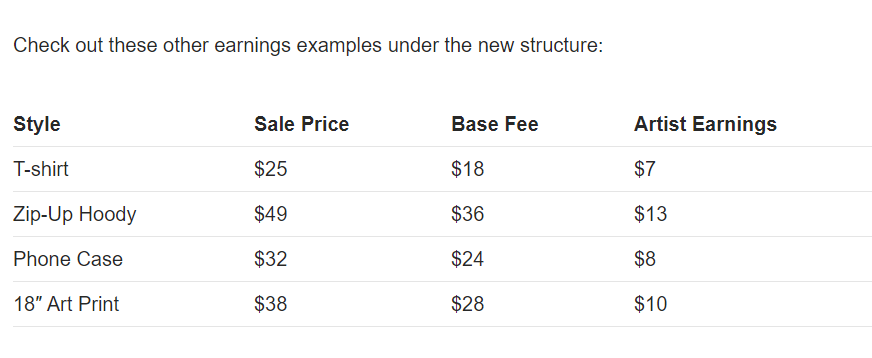
I love Threadless, I do, I make a lot of money there and amazing people work there. However, look at this table, where Threadless claims that you get $7, or around 25%, per t-shirt:

From blog post: “Announcing a massive increase to artist earnings”

There’s no mention of the 10% profit that an artist makes most of the time when their design is bought.

Of course, it’s not surprising that Threadless advertises the $7 that an artist makes from a $25 t-shirt. Threadless wants to pay artists a lot so that artists publish artwork on their website. And in the case of Threadless and Teepublic and a few other websites, I actually do believe that they want to pay artists fairly and support them.

The table looks nice but overpromises. Artists expect a 25% profit, but instead, when there is a sale, they earn a lot less than they thought they would, and so they feel punished.

How should this table look to make an artist feel rewarded instead of punished? There should be two columns:

  • one column with a 10% profit for when an item is on sale,
  • and another column with BONUS PROFIT for when an item is not on sale.

Threadless does an amazing thing here, which they don’t advertise at all. When an item is not on sale, they give artists a disproportionate percentage of additional profits. This is an opportunity to make artists feel rewarded.

December 7, 2020 Tagged With: Mindset, Money

Lulled

What would happen if you were fired today? Do you have a plan?
Photo by Dan Gold on Unsplash

Matt worked at a large company producing branded fruit juices. He was a marketing director, one of the four marketing directors there. But when the profits decreased the company restructured, laid off hundreds of people, and fired 3 of the 4 directors. Matt was one of them.

They let him keep his business car. I met Matt when I took an Uber and he was the driver. He’s been trying to find a new marketing job for the past 3 years. He said there were no marketing jobs for guys his age, and at least he had his car but he worried about the wear and tear on it. He had to bide his time until retirement.

I talk with all the drivers that want to talk so I hear stories like this often. I used to worry that I would fall into this trap too — that I would be good at something and get comfortable but then somehow lose it all and not be able to earn money anymore. Every time I heard about someone being fired and not having any other skills, it was scary because I could see myself following those same steps.

A regular paycheck lulls you into a false sense of security. Most people feel safe when they are employed and then when they lose their jobs their world shatters.

“In times of peace, prepare for war.”

Does it sound dramatic to you? What would happen if you were fired today? What if no one wanted to hire you for a similar job? Do you have a plan? More importantly, do you have the skills to earn money anyway?

December 6, 2020 Tagged With: Mindset

You will not starve

Be an artist, you won't starve.
Photo by Kon Karampelas on Unsplash

I watched Brandon Sanderson‘s keynote speech “Ten Things I Wish I’d Known as a Teen Author” and one thing stuck with me. When he was young people discouraged him from becoming a writer, they thought he would be unemployed. They told him that it was a one in a million chance.

It’s the same with artists!

When I was a kid my grandma told me that I should become a teacher because it’s’ a safe profession. No one took drawing seriously and people told me it was a waste of time. Maybe because in their mind they have this picture of a lonely artist making one painting after another and then trying to sell them on the street, and failing, and then dying poor and unknown.

It’s so at odds with what it’s really like to be an artist.

There are now hundreds of opportunities. Sure you can paint oil paintings, but artists are also sought after to illustrate books, design covers, work on video games and movies, make fabric patterns, design art for clothes, household items, tattoos, posters, greeting cards, and hundreds of other things.

Brandon wished someone had told him that being a writer was a viable job choice. I wish I had found out sooner that being an artist is a completely fine job. Only by, sort of, an accident, I found out you can earn money by drawing things and printing them on t-shirts.

Will this post be useful to anyone? Maybe an aspiring artist reads this and it will be a counterpoint to the people in their life insisting that they choose a safer job.

December 4, 2020 Tagged With: Mindset

  • Go to page 1
  • Go to page 2
  • Go to Next Page »

Primary Sidebar

About Me

My name is Justyna. I am an artist and an indie game developer.

Let’s connect!
@JustynaDorsz

LINKS

Cat Book Newsletter
Fox Shiver – my designs!
TRUFFLEPIG – cats!
Our Games

  • Instagram
  • Pinterest
  • RSS
  • Twitter

My designs

AND MORE…

I rarely send something...

Popular posts

  • Can you make money on Threadless?
  • reMarkable 2 Review
  • Unity Input System vs Rewired
  • Why you don’t see your designs on Threadless
  • Is Threadless worth it?
  • Roam Research – Templates
  • My most popular design ever
  • Overthinking and also hungry
  • I hired a law firm
  • How to name your store

USEFUL

DMCA Template

Topics

  • Advice (27)
  • Art (12)
  • Artist Life (12)
  • Cats (66)
  • Copyright (10)
  • Design (88)
  • Games (8)
  • Law (8)
  • Mindset (14)
  • Money (11)
  • Our book (14)
  • reMarkable (9)
  • Stats (10)
  • Threadless (33)
  • Threadless Artist Shop (13)
  • Work in progress (12)

Footer

  • Instagram
  • Pinterest
  • RSS
  • Twitter

Newsletter

Justyna Dorsz · Copyright © 2012–2026 · Log in